
Investing in Our Team, So We Can Keep Giving Your Pets the Best Care
We often talk about investing in equipment, facilities and services, but one of the most important investments we can make is in our staff.
Veterinary care is always changing. New research becomes available, techniques are refined, and treatment options continue to develop. What we can offer pets today is often very different from what was available years ago, and that is something to be excited about.
For our team, continued learning is not simply a box to tick. It is part of how we make sure that every pet who comes through our doors benefits from up-to-date knowledge, thoughtful decision-making and compassionate care.
Why continued learning matters
Continuing Professional Development, or CPD, is a professional requirement for veterinary teams. The Royal College of Veterinary Surgeons requires veterinary surgeons to complete 35 hours of CPD per calendar year, while registered veterinary nurses must complete 15 hours. Both vets and nurses are also expected to reflect on what they have learned, so CPD is not just about attending a course or watching a webinar. It is about thinking carefully about how that learning can improve patient care.
Of course, in a busy veterinary practice, finding time for training is not always easy. Our days can be full of consultations, operations, phone calls, emergencies, follow-ups and those little moments of comfort that mean so much to worried owners. That is why we are especially proud of our team when they give their time and energy to learning, often after already giving so much to their patients during the day.
A recent CPD evening at Chalkland Vets
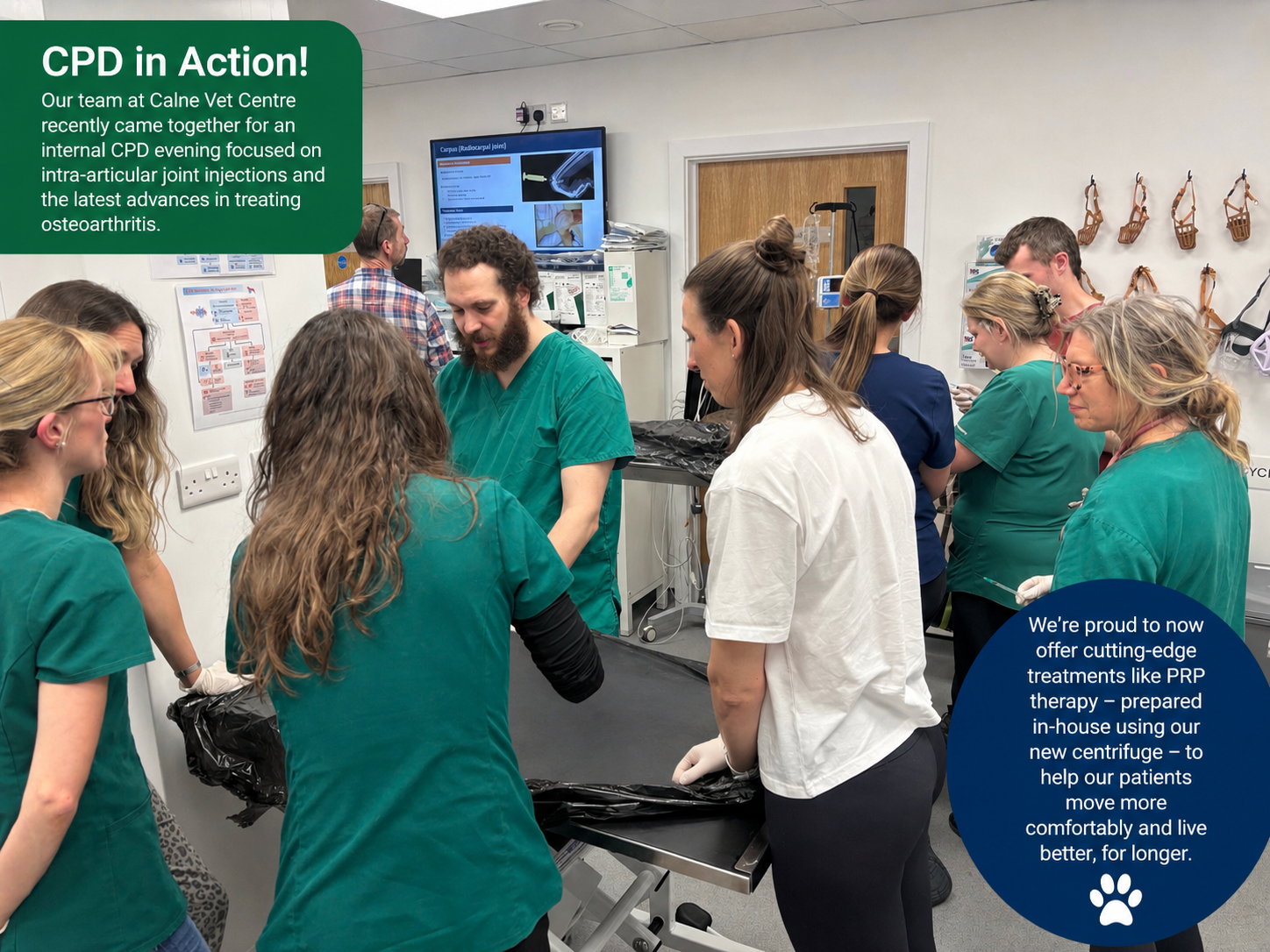
Recently, our hardworking vets came together for an internal CPD evening focused on intra-articular joint injections and the latest advances in osteoarthritis treatment.
It was a chance to spend time looking closely at joint disease, pain management and some of the newer options that may be available for pets who are struggling with mobility or long-term discomfort. Sessions like this are valuable because they give the team space to ask questions, discuss cases, share experience and consider how new knowledge might fit into everyday practice.
Understanding osteoarthritis in pets
Osteoarthritis is something we commonly see in pets. It can affect older dogs and cats, but it is not only a condition of old age. It can also occur following injury, joint abnormalities, previous surgery or years of wear and tear.
The signs can sometimes be subtle. A dog might be a little slower on walks, hesitate before jumping into the car, or seem stiff after resting. A cat may stop jumping onto favourite spots, sleep more than usual, or become less tolerant of being handled.
These changes are easy to dismiss as “just getting older”, but many pets with joint pain can be helped. That is why keeping up to date with osteoarthritis treatment matters so much. The more we learn, the better we can support pets in a way that is tailored to them.
Learning about regenerative therapies
During the CPD evening, the team spent time learning more about regenerative therapies such as PRP, which stands for Platelet-Rich Plasma.
PRP involves using a patient’s own blood, processing it to concentrate the platelets, and then using that preparation as part of a treatment plan. Platelets contain growth factors, which are involved in the body’s natural healing processes. For some patients with joint disease, PRP injections may help improve comfort, mobility and quality of life.
It is important to say that no treatment is right for every pet. Osteoarthritis care is often most effective when it is approached from several angles. This may include weight management, pain relief, exercise changes, physiotherapy, hydrotherapy, home adaptations and regular check-ups.
PRP may be one part of that wider picture for some patients, and having the knowledge to decide when it may be appropriate is exactly why CPD is so valuable.
Investing in equipment and expertise
We are also excited to now have our own centrifuge in-house. This allows us to prepare PRP treatments directly within the practice for patients who may benefit from them.
Investing in equipment like this goes hand in hand with investing in our team’s knowledge. There is little point in having new technology unless the people using it understand when, why and how it can help.
By combining training with the right facilities, we can continue to develop the services we offer in a safe, considered and practical way.
A team committed to improving care
What we loved most about the evening was the enthusiasm in the room. It is easy to think of CPD as a professional obligation, but for our team it is also a sign of care. It shows that we want to keep improving. We want to keep asking questions. We want to keep finding better ways to support the pets entrusted to us.
That commitment benefits every patient, not only those who may need advanced treatments. Continued learning influences the way we examine pets, the way we explain options to owners, the way we monitor long-term conditions and the way we work together as a team.
What this means for you and your pet
When you bring your pet to Chalkland Vets, you are not just seeing one vet or one nurse. You are being supported by a team that is continually learning, sharing knowledge and investing in the future of veterinary care.
A huge thank you to our team for their enthusiasm, curiosity and commitment to providing the very best care for our patients.
Categorised in: News